Feng shui compass, also known as the Luo Pan, is the cornerstone of classical Feng Shui, guiding practitioners to harmonize spaces with the flow of Qi. This ancient Chinese tool, far more intricate than a standard compass, unlocks precise directional insights and cosmic alignments.
In this comprehensive guide, BTA’ll explore the Luo Pan’s history, functionality, types, and practical use, offering expert insights to elevate your Feng Shui practice.
What Is a Feng Shui Compass?
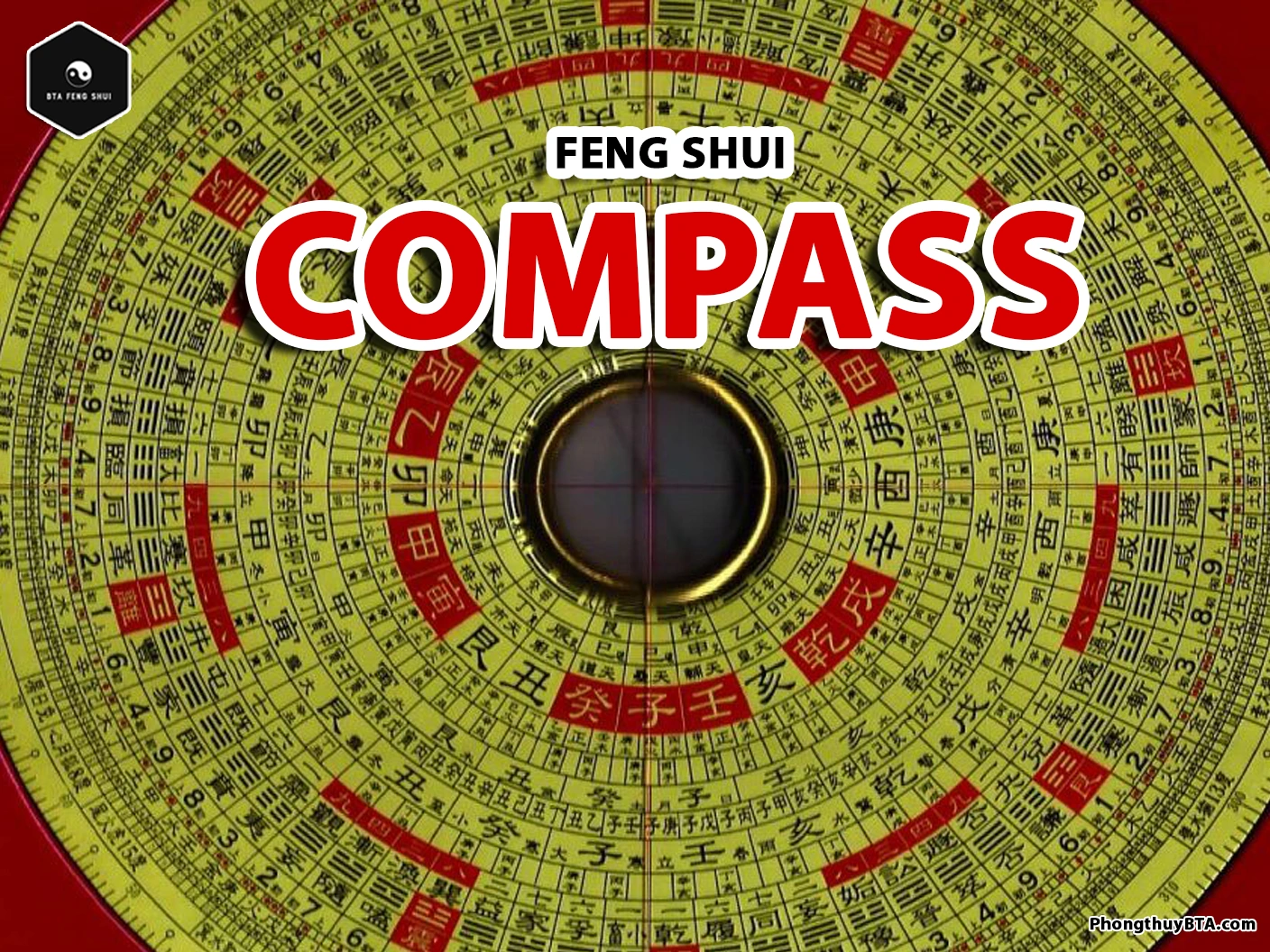
The Luo Pan, or Chinese compass, is a sophisticated instrument used in Feng Shui to determine the precise orientation of a building, room, or object. Unlike a standard compass, which points to the magnetic north, the Luo Pan’s needle aligns with the magnetic south, reflecting its Chinese origins where the “south-pointing needle” (zhinan zhen) was developed.
Its name, combining Luo (net encompassing everything) and Pan (plate), symbolizes its ability to connect Heaven and Earth through electromagnetic fields.
The Luo Pan features a circular metal or wooden plate, called the Heaven Dial, which rotates on a square Earth Plate. Up to 40 concentric rings on the Heaven Dial contain intricate Feng Shui formulas, including the 24 Mountains, trigrams, and astrological data. A red thread, known as the Heaven Center Cross Line, divides the dial into four quadrants, aiding precise directional readings.
History of the Luo Pan
The Luo Pan traces its roots to ancient China, evolving from the shi or diviner’s board used between 278 BCE and 209 BCE. These early astrolabes, found in tombs, charted celestial movements and were used for divination, such as Da Liu Ren.
The schematic of the Luo Pan, with its Heaven Plate, Earth Plate, and grid lines, mirrors the “two cords and four hooks” diagram from the Warring States period. By the Tang dynasty, the magnetic compass emerged, refined over centuries by Feng Shui masters during the Ming and Qing dynasties. Each master added layers of knowledge, making the Luo Pan a repository of classical Feng Shui wisdom.
Types of Luo Pan
There are three primary types of Luo Pan, each tailored to specific Feng Shui schools:
San He Luo Pan
The San He Luo Pan, rooted in the Three Harmonies system, is ideal for beginners. It features three 24-direction rings, each tied to distinct formulas, emphasizing landforms and environmental harmony. This type is often used for assessing external landscapes and their impact on a structure.
San Yuan Luo Pan
The San Yuan Luo Pan, also called the Jiang Pan, is more advanced, incorporating the 64 hexagrams of the I Ching and a single 24-direction ring known as the Earth Plate Correct Needle. It’s central to the Flying Stars system, which analyzes time-based energy shifts, making it essential for precise, time-sensitive readings.
Zong He Luo Pan
The Zong He Luo Pan combines elements of both San He and San Yuan, offering versatility for practitioners who blend both systems. It includes multiple 24-direction rings and the 64 trigrams, catering to complex analyses.
Custom Luo Pans, designed by individual masters, may also incorporate unique formulas or English translations for accessibility, though traditional Chinese versions remain preferred for their depth.
Understanding the 24 Mountains
The 24 Mountains are the heart of the Luo Pan’s directional system, dividing the 360-degree compass into 24 segments of 15 degrees each.
These segments are named using a combination of the 12 Earthly Branches (e.g., Rat, Ox, Tiger), 8 Heavenly Stems (Jia, Yi, Bing, Ding, Geng, Xin, Ren, Gui), and 4 Bagua trigrams (Qian, Kun, Gen, Xun). Each mountain corresponds to a specific direction, such as North 1 (Ren, 337.5°–352.5°) or South 2 (Wu, 172.5°–187.5°).
The 24 Mountains are critical in systems like Xuan Kong Fei Xing (Flying Stars), where they help identify a building’s facing and sitting directions, influencing its energy map. For example, a house facing 180° falls in South 2 (Wu), guiding the practitioner in assessing its Qi flow.
Cardinal and Sub-Cardinal Directions
The Luo Pan divides the compass into eight primary directions (North, Northeast, East, etc.), each spanning 45 degrees. These are further subdivided into three 15-degree segments, creating the 24 Mountains. The cardinal directions (North, South, East, West) have Yang Earth positions, while sub-cardinal directions (Northeast, Southeast, etc.) have Yin Earth positions, marked in red or black for clarity.
How to Use a Luo Pan
Using a Luo Pan requires precision and an understanding of Feng Shui principles. Here’s a step-by-step guide:
- Locate the Facing Direction: Identify the most Yang part of the building, typically the facade, main entrance, or area with the largest windows. Avoid assuming the front door is always the facing direction, especially in urban settings.
- Position Yourself: Stand with your back parallel to the facade, facing outward (e.g., toward a sea view or open street). Hold the Luo Pan level, using the built-in spirit level for accuracy.
- Align the Compass: Rotate the Heaven Dial until the red needle aligns with the magnetic south. The red thread should intersect the center, pointing to the direction you’re measuring.
- Read the Degrees: Note the degree reading where the red thread crosses the 24 Mountains ring. For example, a reading of 100° corresponds to East 3 (Yi).
- Take Multiple Readings: To ensure accuracy, take several measurements along the facade and compare with the sitting direction (opposite the facing). For instance, a 90° East facing should have a 270° West sitting.
- Avoid Magnetic Interference: Steer clear of metal objects, electronics, or underground structures that could distort the needle’s movement.
Precautions for Accurate Readings
- Check Needle Movement: Ensure the needle floats freely, unaffected by stuck mechanisms or external magnets.
- Measure Outdoors: Indoor readings may be skewed by metal beams, wires, or appliances. Take external measurements for reliability.
- Use Quality Equipment: Invest in a professional Luo Pan with a clear degree scale (ideally 1° or 0.5° precision) and aligned threads.
Why the Luo Pan Matters in Feng Shui
The Luo Pan is more than a directional tool; it’s a gateway to understanding a space’s energy dynamics. By integrating the 24 Mountains, trigrams, and astrological data, it enables practitioners to:
- Assess Qi Flow: Determine how energy enters and circulates within a space, based on its facing and sitting directions.
- Apply Flying Stars: Use time-based calculations to identify auspicious and inauspicious energies, guiding furniture placement or renovations.
- Harmonize Environments: Align a building with its surrounding landforms, such as water (for wealth) at the front or mountains (for support) at the back.
For example, in the Flying Stars system, a timely Water Star at the front door, paired with a water feature, can enhance prosperity, while a Mountain Star at the back, supported by a tall structure, promotes harmony.
Choosing the Right Luo Pan
When selecting a Luo Pan, consider:
- Size and Rings: Smaller Luo Pans (4”–8”) are portable but have fewer rings, while larger ones (12”–36”) offer more formulas. Beginners may start with a San He, while advanced practitioners prefer San Yuan or Zong He.
- Precision: Opt for a compass with a 1° or 0.5° scale for professional accuracy.
- Quality: Ensure the needle is high-quality, the Heaven Dial rotates smoothly, and the threads are precisely aligned.
- Language: Traditional Chinese Luo Pans offer deeper insights, but English versions are more accessible for beginners.
Practical Tips for Beginners
- Start Simple: Use a basic feng shui compass or San He Luo Pan to master the 24 Mountains before advancing to complex rings.
- Practice Outdoors: Take readings in open spaces to minimize interference and build confidence.
- Learn the Basics: Study the Five Elements, Eight Trigrams, and 12 Earthly Branches to interpret the Luo Pan’s rings effectively.
- Consult Experts: Enroll in courses from reputable schools like the Feng Shui Institute to deepen your understanding.
The Luo Pan is a powerful tool for aligning your space with the natural flow of Qi. Mastering its use helps you create harmony, attract prosperity, and apply classical Feng Shui with precision. Explore its potential and transform your environment today!
If you found this guide helpful, please rate it 5 stars and share it with others seeking Feng Shui wisdom!